The straight two-arm model and why to fit it
In this post we will use a simplified model to start understanding why handstands are intrinsically unstable. Only the model is simple, because, to me, the straight handstand is anything but simple.
Toolbox
-
Rigid body: an idealisation in which the distance between any two points of the body stays constant: the body does not deform and can only translate and rotate. In biomechanics, the human body is often represented as a rigid-body model.
-
Angular velocity (ω): how fast the tilt angle changes over time [rad/s]. It is the time derivative of θ.
-
Angular acceleration (α): how fast the angular velocity changes over time [rad/s²].
-
Centre of mass (CoM): the point where the whole mass of a body can be considered concentrated, and which moves like a single particle subject to the total external force.
-
Lever arm: the perpendicular distance between the line of action of a force and the axis of rotation [m].
-
Pivot: the fixed point about which the body rotates. In the model it is the wrists.
-
Amplitude (θ₀): the maximum angle reached during the oscillation.
-
Angular frequency (ω₀): how fast the oscillation cycles [rad/s]. It is related to the period by T = 2π/ω₀.
-
Period (T): the time taken for one complete oscillation [s].
-
Moment of inertia (I₀): a measure of a body’s resistance to changes in its rotation, here about the pivot (the wrists) [kg·m²].
-
Control torque (τ): torque generated by the muscles, equal to the force times its lever arm [N·m].
-
Tilt angle (θ): angle between the body axis and the vertical [rad].
Single inverted pendulum: a more accurate model for humans
The body tilting in a handstand is more similar to what in physics is known as single inverted pendulum (SIP), a pendulum where the centre of mass is above the pivot point. Due to its configuration, the system implements control logic to not falling, being a common model used in biomechanics applications that involve balance, like gait analysis, upright position and athletic skills, including handstands. (Figure 1).
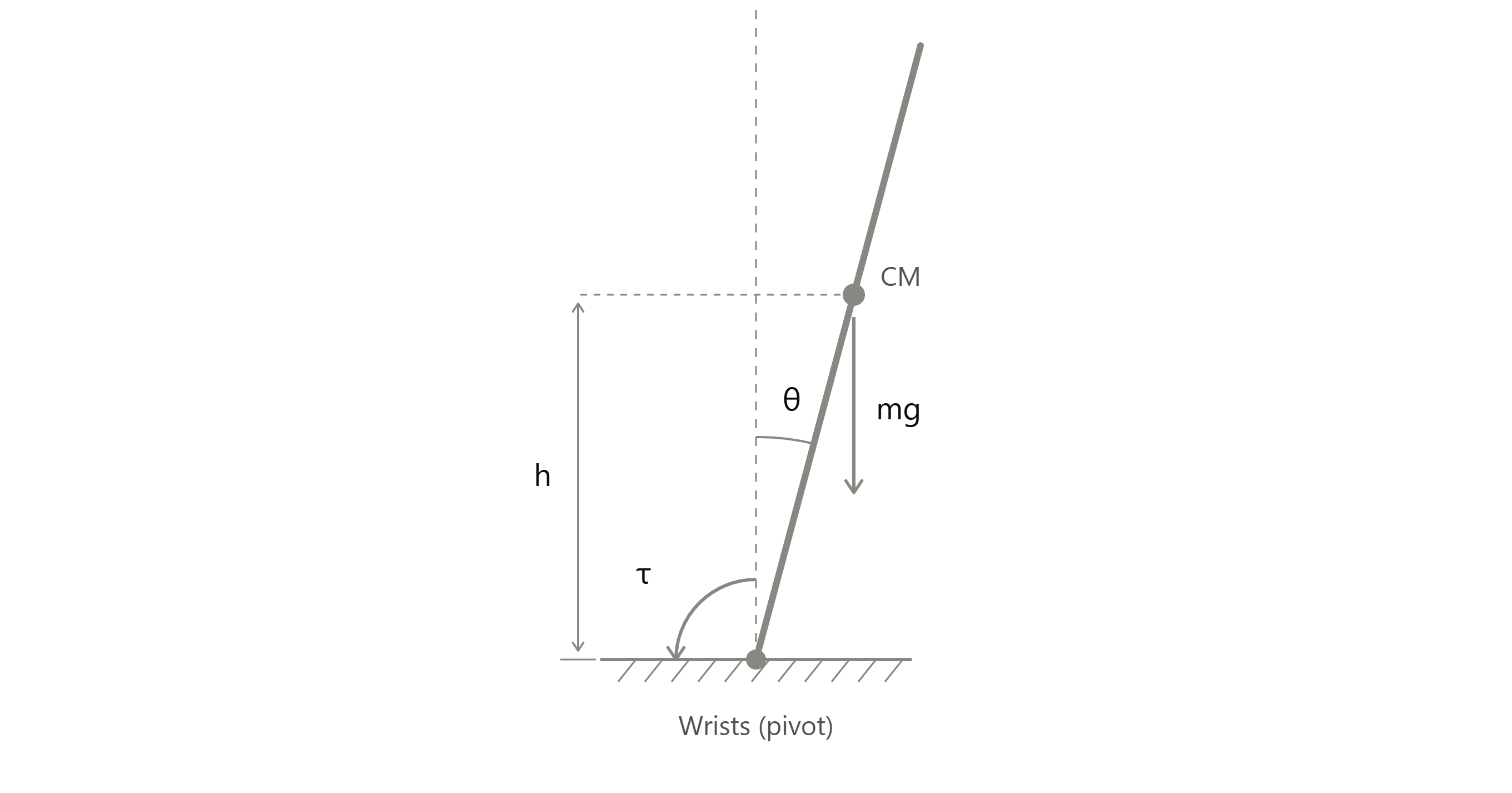
In this configuration, equations of motion become:
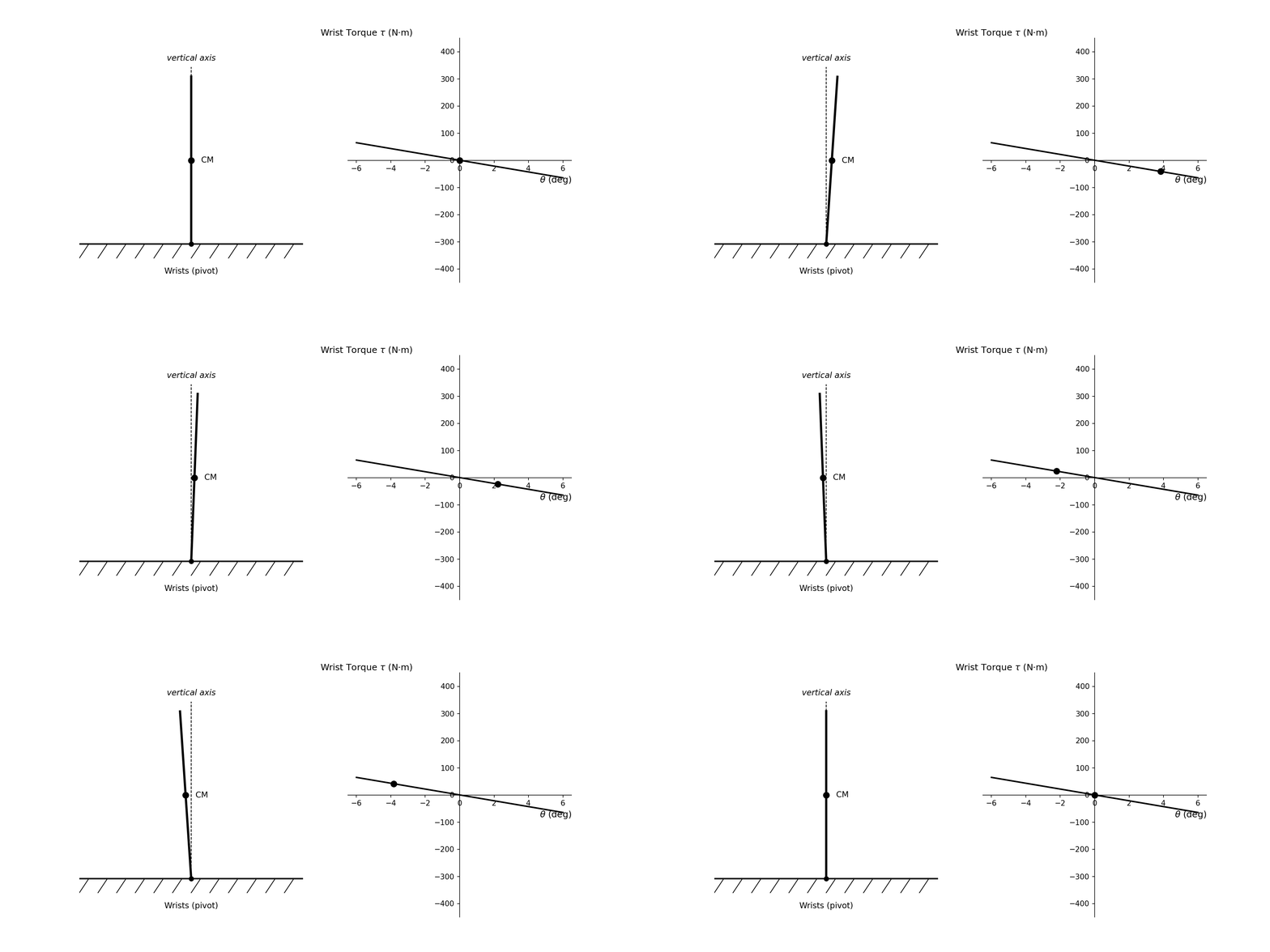
\[\sum M_{O} = I_{O}\,\alpha = mgh\sin\theta+\tau = 0\] \[mgh\sin\theta = - \tau\]where θ is the angle between the body axis and the vertical, suggesting that the magnitude of the torque generated by the wrist muscles depends on the tilt angle (Figure 2).
This is reasonably consistent with what we observe in practice: small oscillations usually call for small adjustments that are not too demanding in terms of muscular effort. When the tilt becomes too large, the wrists can no longer counteract the moment generated by gravity, and we fall.
You’re not a simple harmonic oscillator
To introduce this topic, it is helpful to briefly revisit the simple pendulum and its equation of motion.
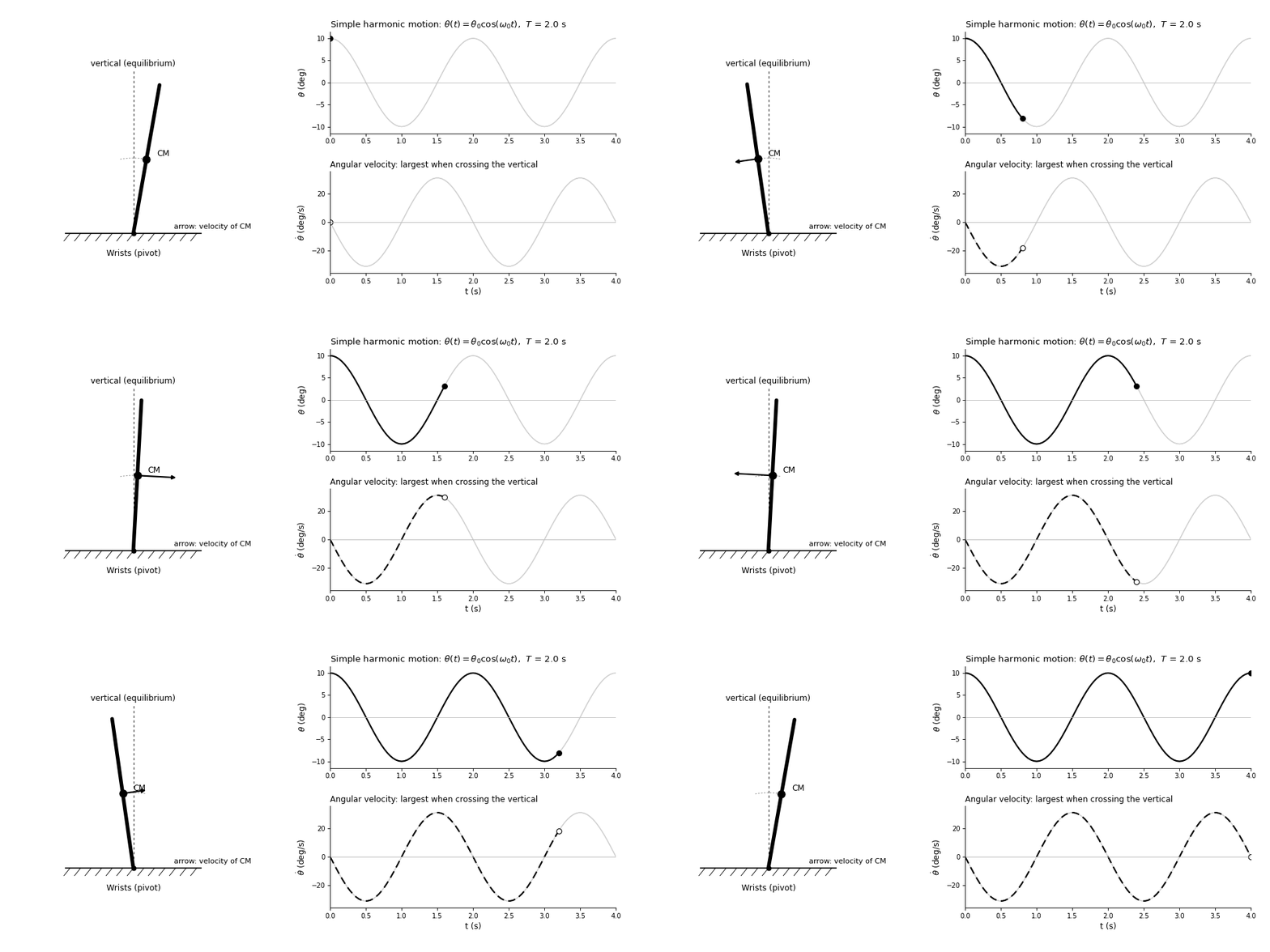
In a simple hanging pendulum (the one whose body is suspended from a fixed point that swings freely under gravity) the centre of mass describes harmonic motion, at least for small oscillations. In the ideal case, the angular position over time is modelled by a cosine function, \(\theta(t) = \theta_0 \cos(\omega_0 t)\), where \(\theta_0\) is the initial amplitude and \(\omega_0\) is the angular frequency.
I understand this may sound tedious and long-winded, but there is a reason why understanding the difference between the hanging pendulum model and the inverted pendulum model matters.
And in case you didn’t know, I love waves.
Under this regime, its velocity continuously changes direction at the oscillation limits and varies in magnitude, reaching its maximum as the system crosses the vertical reference line.
This is what happens, more or less, to your centre of mass when you use you fingers to recover balance. In fact, the common wisdom about controlling a handstand revolves around this idea: if you are falling forward, push with your fingers; if you are falling backward, push with your palms. What you are being asked to do is behave like a harmonic oscillator.
Unfortunately for those who who genuinely approach handbalancing, as we have seen from the equation above, this result cannot be achieved without active control at the wrists (\(\tau\)).
Yet, an ideal inverted pendulum cannot be mathematically described by simple harmonic motion: it diverges exponentially from the vertical (for small angles). In other words, what we would like to obtain is simply not supported by the underlying physics of the system.
This is due to the unfavorable configuration we occupy within the gravitational field: our pivot point is located at ground level, while the entire weight of our body is distributed above and rotates around it.
When balancing on hands, you (the inverted pendulum) are being asked to behave like a simple pendulum, turning an unstable system into one that oscillates about the vertical (our handstand).
Furthermore, even a real hanging pendulum does not behave like an ideal hanging pendulum, and you are not a hanging pendulum. Gravity is against you, and the system you most resemble is unstable by nature: left to itself, it tends to fall.
In short, in a hanging pendulum, harmonic motion (which is what we want our centre of mass to do around the vertical) is the natural behaviour of the system and needs no control, because gravity provides the restoring torque that brings it back to equilibrium. In an inverted pendulum, gravity pushes us away from equilibrium, so we have to counteract it and recreate the harmonic oscillations ourselves.
Luckily, in reality, you are not a hanging pendulum, nor a inverted one, and you can train your muscles to describe what type of motion you want (differently from pendulums, they learn). So, once again: understand how the motion works, what its characteristics are, and how to reproduce it with our body.
With active wrist control, we can create behaviour that resembles simple harmonic motion.
In other words, nature will not produce restoring torques for you, but at least has provided you with the neuromotor control system which can learn how to generate them (Figure 3).
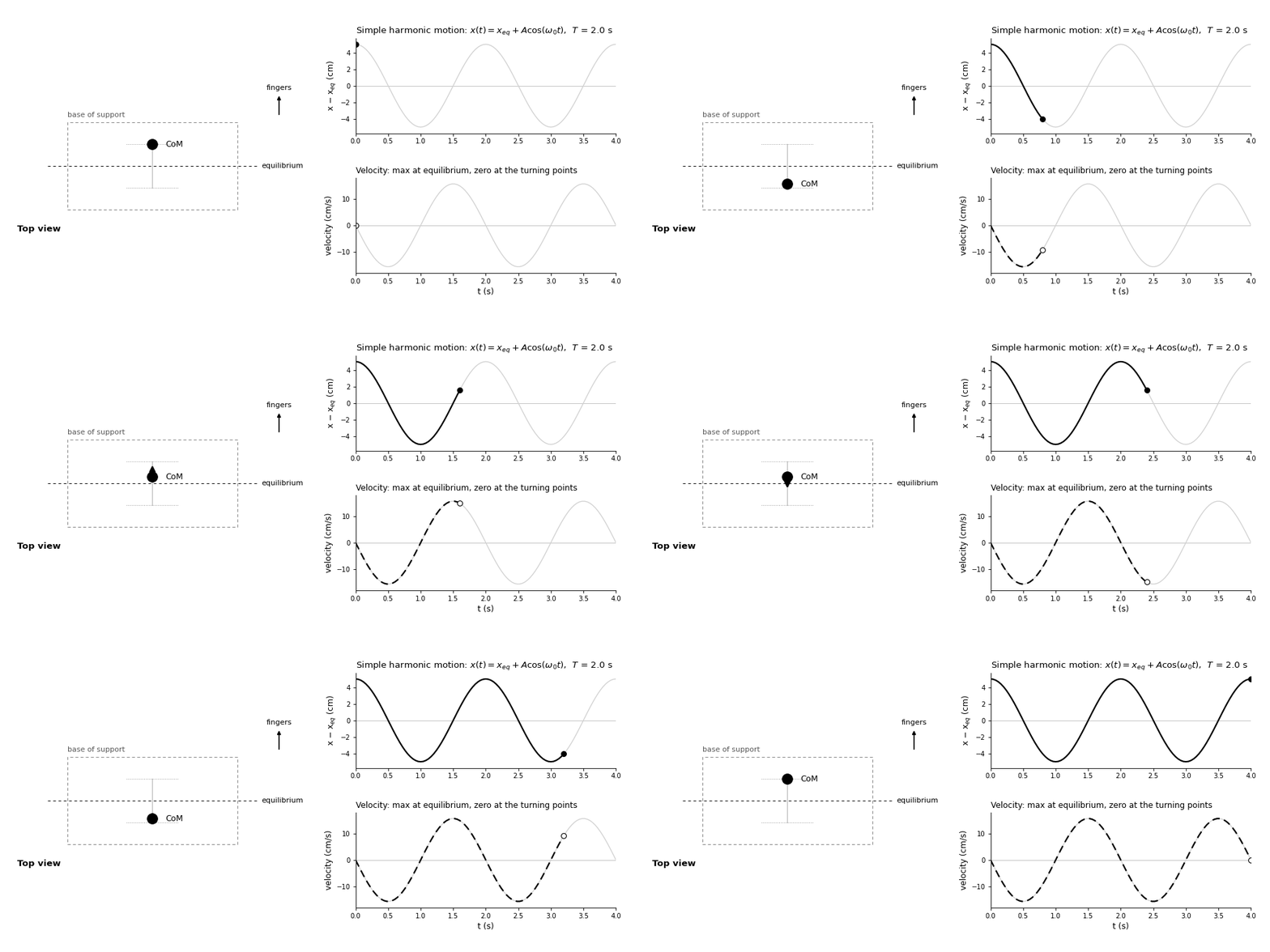
In short, the ability to recover balance depends on the torque we can generate at the wrists.
If in doubt, be a pendulum
Either way, whether you are a hanging pendulum or an inverted one, being a pendulum is what truly matters: as we will see, this is the simplest configuration to study and define, and therefore the simplest case in which to predict and contain perturbations. Unfortunately, holding the posture that makes the body behave like a pendulum is very hard, and it involves non-trivial muscle activations. This is the reason why more experienced athletes, who have greater neuromuscular control, perform better in this specific task and are better able to maintain the position. As I said at the beginning of the post, the straight handstand was the hardest position for me to learn. Not to understand, but to actually learn. Things improved when I learned the correct posterior pelvic tilt. In the next posts we will look at what these activations are and how they affect the model.
Moreover, because of the dependence of \(\tau\) on \(h\), this result also suggests that the magnitude of the torque required to recover balance depends on the height of the center of mass, meaning that taller people may struggle more in handstands (Figure 4).
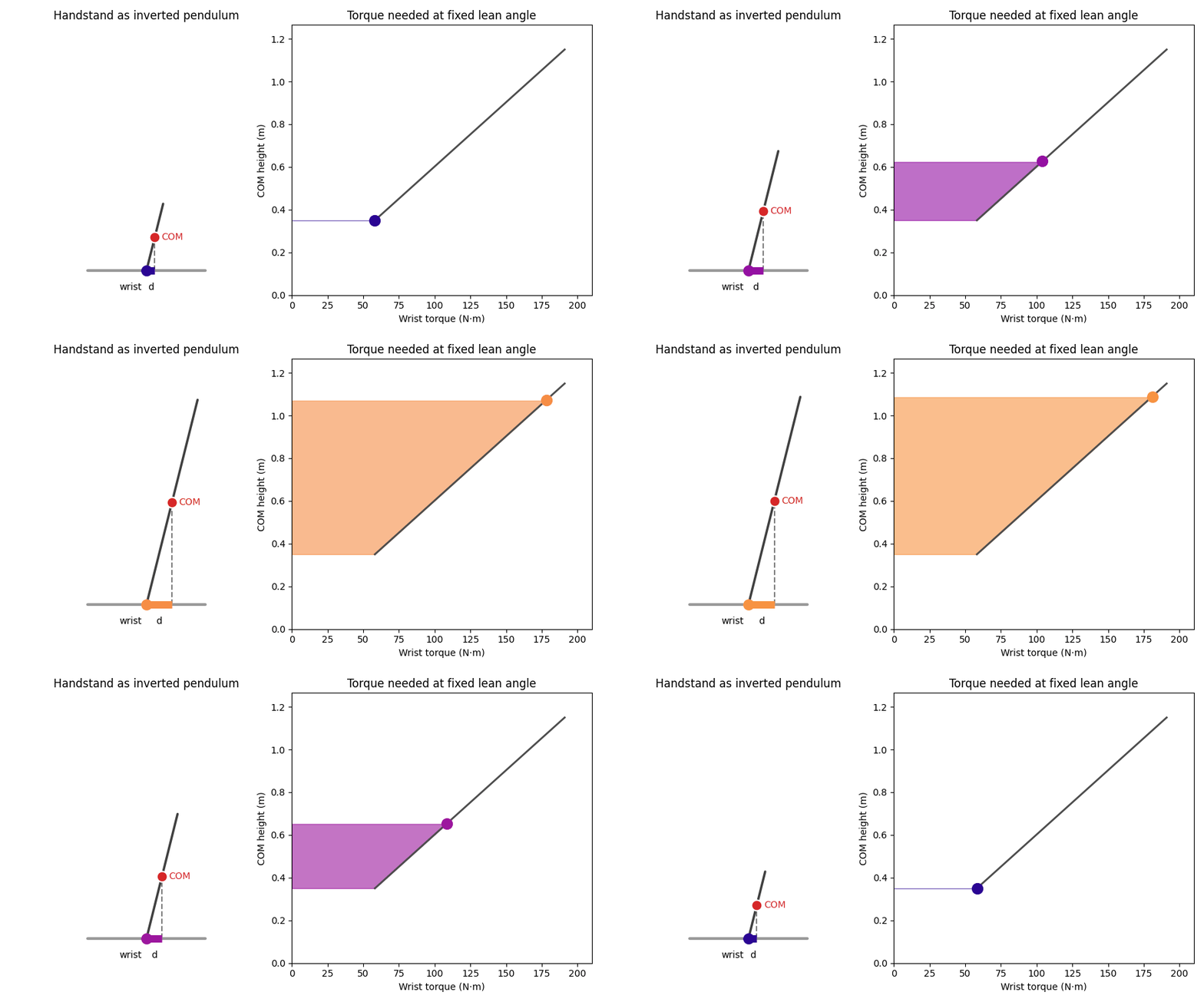
In the next posts, we will see that other parameters also play a role and that the wrists can exert only a limited torque, bounded by the size of the contact area under the hands: if \(mgh\sin\theta\) exceeds that limit, the fall can no longer be stopped.
This post is part of the handstand balance model. Next: an energy perspective on handstands balance →
Sources and references
- Frontiers - Biomechanical analyses of the handstand: a systematic review
- Chris Gatti - A simple model of the handstand
- Figures 1 and 2 - AI-generated illustration created with Claude (Anthropic) for dopamine-chamber.github.io
- Figures 3, 4 and 5 - Generated via Python for dopamine-chamber.github.io